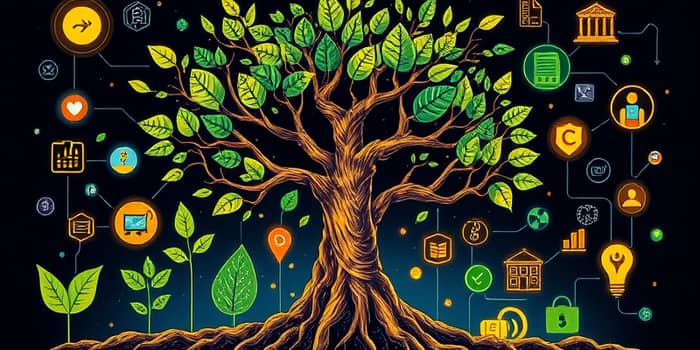
In an era of rapid change, understanding finance as an ecosystem helps individuals navigate complexity with clarity and purpose.
Understanding the Financial Ecosystem
A financial ecosystem is a network of private and public actors working in concert to provide essential services. From traditional banks to cutting-edge fintech startups, regulators and customers all interact to create a dynamic, evolving environment shaped by technology, regulation, customer demand, and global events.
At its core, the ecosystem performs five basic life functions that sustain economic activity:
- Funding allocation – matching surplus funds with productive uses.
- Maturity transformation – converting short-term deposits into long-term credit.
- Risk transfer and pooling – distributing risk via insurance and markets.
- Payments and settlement – facilitating secure value exchange across systems.
- Price discovery and information – integrating data into market prices.
These processes rely on digital platforms and cloud-based infrastructure, robust legal frameworks, behavioral trends, and geopolitical forces to evolve and adapt. When crises strike, they reveal fragilities, prompt regulation, and open space for innovation.
Within this vast macro structure lies the fintech ecosystem—a vibrant subset of startups, traditional banks, tech providers, investors, regulators, and consumers collaborating to drive financial innovation leveraging cloud, AI, and data analytics through APIs, blockchain, and advanced cybersecurity tools.
Your Personal Financial Ecosystem
Just as markets and institutions form a macro structure, each person operates within an integrated personal financial universe comprising various assets, liabilities, and behaviors. Recognizing these interconnections empowers you to optimize every part for collective strength.
Key components include:
- Flows: income, spending, saving, investing, debt payments.
- Assets: cash reserves, retirement accounts, investments, home equity.
- Liabilities: credit cards, student loans, mortgages, personal loans.
- Protections: insurance policies, emergency fund, legal safeguards.
- Infrastructure & tools: banks, fintech apps, employer benefits, advisors.
- Behaviors & beliefs: spending habits, risk tolerance, financial literacy.
Mirroring macro functions at the personal level brings clarity. Allocating income across needs, wants, and savings becomes your funding model. Balancing short-term liquidity with long-term goals is akin to maturity transformation. Insurance and diversification offer mechanisms for risk transfer and pooling, while budgeting and credit monitoring tools ensure effective price discovery and information governance.
Balancing Growth and Resilience
In personal finance, growth and resilience are not opposites but complementary goals. Growth expands your net worth and opportunities, while resilience ensures you withstand setbacks without derailing long-term progress through steady liquidity and strategic investments.
Today’s environment—characterized by rising living costs, volatile interest rates, and sudden economic shocks—underscores the need for a sturdy safety net. Many households struggle to handle even moderate unexpected expenses, making liquidity and preparedness non-negotiable.
Two widely respected benchmarks guide this balance:
- Emergency fund target – three to six months of essential expenses.
- Budget framework – the 50/30/20 rule for allocating income to needs, wants, and savings.
Cash Flow and Budgeting
Robust growth and resilience begin with stable, predictable cash flow management. A clear budget acts like nutrient-rich soil in which your financial tree can flourish.
Start by listing all income sources and fixed expenses: rent or mortgage, utilities, insurance, debt payments. Then track variable expenses such as groceries, transportation, and subscriptions. Using the 50/30/20 guideline provides a simple framework for setting limits and priorities.
Organize your accounts into distinct buckets—one for daily transactions and another for reserves. Review and adjust your plan monthly or quarterly to reflect changes in income, costs, and goals.
Managing Debt
Debt can either amplify risk or fuel opportunity. Responsible use of low-cost borrowing for education or business investment can boost growth, but high-interest balances are a major drag on both stability and progress. Approach this by using detailed statements and prioritized payoff strategies with measurable deadlines.
Begin by listing every debt with its balance, interest rate, and minimum payment. Prioritize high-interest obligations first—credit cards and payday loans—and consider the debt avalanche or debt snowball methods. Free up cash by trimming discretionary spending, negotiating better rates, or refinancing when feasible. Avoid new high-cost debt until you regain control.
Building an Emergency Fund
An emergency fund serves as the ecosystem’s shock absorber for unexpected expenses. Whether facing car repairs, medical bills, or job loss, this buffer keeps you from resorting to high-cost credit and losing momentum.
To build it, start small and stay consistent—automate contributions from checking to a liquid savings account. Aim for at least three months of essential expenses, stretching to six months if income is variable or dependents rely on you.
Savings and Investing
Long-term growth emerges when you channel excess cash into savings and investment vehicles. Increase your savings rate by cutting expenses in your budget and setting automated transfers aligned with paydays, enabling consistent capital deployment over time.
Align savings with specific goals: short-term funds for travel, medium-term plans like a home down payment, and long-term retirement accounts. Diversified investments matched to your time horizon and goals benefit from time horizon and compounding to maximize growth while managing risk.
Monitor macroeconomic shifts—interest rates, inflation, regulatory developments—and rebalance your portfolio accordingly to maintain harmony with your objectives.
Insurance and Protection
A complete financial ecosystem includes risk transfer mechanisms through insurance coverage such as health, life, disability, and property policies that shield you from devastating financial losses.
Review coverage limits, premiums, and exclusions annually. Complement these policies with legal documents—wills, powers of attorney, and healthcare directives—to ensure your assets and loved ones are protected under any circumstances.
Monitoring and Adaptation
Regularly monitoring your financial ecosystem ensures you spot trends, gaps, and emerging risks before they escalate into crises. Use budgeting apps, credit reports, and investment dashboards to gain real-time visibility and data-driven decision making insights.
Schedule quarterly reviews to assess progress toward goals, adjust allocations, and refine strategies. When life events—like a career change, marriage, or market downturn—occur, revisit your plan to confirm it still aligns with your circumstances and aspirations.
Behavior and Mindset
Behaviors and beliefs shape every decision in your financial ecosystem. Cultivate habits of regular review, lifelong learning, and emotional discipline. Recognize biases—like overconfidence or loss aversion—and counteract them by embracing data-driven planning and reflective practices.
Set clear goals, celebrate milestones, and maintain flexibility to adapt when life or markets change. A resilient mindset, paired with sound practices, ensures you nurture growth without sacrificing stability.
By viewing your finances as an ecosystem, you create a cohesive strategy that balances growth and resilience. Each element—from budgeting and debt management to investing and protection—interacts and strengthens the whole. Cultivate this system with care and vigilance, and you’ll weather storms, seize opportunities, and build lasting prosperity.
References
- https://blog.brankas.com/fintech-ecosystem/
- https://www.hvcu.org/learning-center/building-financial-resilience-strategies-for-overcoming-financial-stress/
- https://jemi.edu.pl/call-for-papers-archive/603-financial-ecosystems-concepts-and-practice
- https://www.hopecu.org/articles/building-financial-resilience-how-to-navigate-financial-challenges/
- https://anandautar.substack.com/p/the-financial-ecosystem-a-foundational
- https://focusok.com/building-financial-resilience-strategies-for-overcoming-financial-stress/
- https://www.zuehlke.com/en/insights/financial-services-ecosystem-guide
- https://esg.sustainability-directory.com/area/financial-ecosystem-components/
- https://www.jpmorganchase.com/institute/all-topics/financial-health-wealth-creation/building-financial-security-and-resilience
- https://menttor.live/library/understanding-the-financial-ecosystem
- https://www.tristatefa.com/Three-Ways-to-Help-Build-Financial-Resilience.c10431.htm
- https://rpc.cfainstitute.org/research/cfa-magazine/2017/financial-ecosystems-a-survival-guide
- https://equitable.com/perspectives/planning/2024/six-ways-to-turn-a-crisis-into-a-fresh-financial-start
- https://www.ey.com/en_gl/industries/financial-services/ecosystems-financial-services/how-harnessing-the-power-of-ecosystems-can-make-finance-effortless
- https://www.breadfinancial.com/en/financial-education/responsible-saving/building-financial-resilience.html