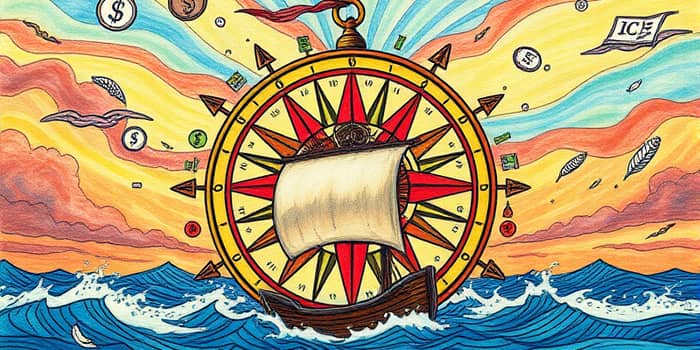
In an ever-changing economic environment, borrowing wisely can mean the difference between thriving and merely surviving. Just as sailors rely on a compass to navigate stormy seas, individuals and institutions depend on sound financing conditions to steer toward prosperity.
Understanding Financial Stability
Financial stability is more than the absence of crises. It describes a system’s capacity to withstand shocks through self-corrective mechanisms and efficient resource allocation, ensuring that families, businesses, and markets function smoothly.
Key definitions include resilience to stress, uninterrupted access to borrowing and saving needs, and the ability of institutions to support economic activity, even under duress. Short-term stability provides a cushion, making sure people are able to handle daily shocks while moving forward with their goals.
The Role of Borrowing in Economic Resilience
Borrowing serves as the transmission mechanism linking central bank policies to real outcomes. Upstream measures, such as risk-free rates and sovereign yields, set the compass bearing. Downstream effects appear when banks extend credit to households and firms, fostering spending and investment.
When financing conditions are favourable—marked by low costs and ample availability of credit—confidence grows, spending rises, and economies sail steadily even when faced with inflationary gusts.
Identifying Favourable Financing Conditions
The ECB’s compass framework relies on two categories of indicators:
- Upstream indicators: Overnight Index Swap (OIS) rates and sovereign bond yields that benchmark borrowing costs.
- Downstream indicators: The cost and volume of bank credit to households and firms, accounting for roughly 43% of external finance between 2009 and 2018.
Policy tools such as targeted refinancing operations (TLTROs), asset purchase programs (PEPP), and temporary collateral easing reduce uncertainty and bolster lending capacity.
Risks and Vulnerabilities in Borrowing
Uncertainties in asset values, borrower repayment capacity, and bank capital can trigger lending slowdowns. When banks tighten standards, households and firms interpret it as a sign of impending weakness, leading to reduced spending—a self-reinforcing loop.
Frozen secondary markets, which once financed nearly half of small business and consumer loans, exacerbate this dynamic. Nonperforming loans serve as a lagging indicator of stress, but after the 2007–09 crisis, higher capital requirements, stress tests, and countercyclical buffers have fortified the system against major disruptions.
Borrower-Centric Principles for Responsible Credit
Ensuring that borrowing supports rather than hinders financial health requires adherence to core principles:
- Underwriting based on ability to repay and avoiding terms that trap borrowers in cycles of debt.
- Transparent total credit costs at the point of application, with reasonable grace periods to prevent penalty fees.
- Targeted support for first-time borrowers, including small-dollar secured loans and positive payment reporting to credit bureaus.
- Integration of loans with savings opportunities to build resilience for those with limited credit histories.
Evidence-Based Programs and Strategies
One promising initiative is the Compass Financial Stability Model, which combines incentive-based coaching with structured savings. Participants receive guidance on income, credit, and asset-building, along with an escrow account that rewards consistent contributions.
Participants report stronger budgeting habits, improved creditworthiness, and a heightened sense of control over their finances.
Systemic Tools for Sustaining Stability
Macroprudential policies reinforce the financial compass at the system level. Regulators conduct stress tests and capital buffers to ensure large banks can absorb losses, while central banks use forward guidance and asset purchases to maintain favourable conditions.
- Countercyclical capital buffers raise resilience when risks build up.
- Government-guaranteed loan programs ease credit standards during downturns.
- Comprehensive monitoring tracks the full transmission gamut from upstream rate changes to downstream lending flows.
Path Forward: Navigating Your Financial Journey
For individuals, the journey begins with realistic budgeting, understanding credit terms, and building savings to cushion against shocks. Seek out products that emphasize transparent costs and support steady repayment.
At the institutional level, lenders should commit to borrower-centric underwriting and monitor emerging risks in real time. Policymakers must maintain agile tools—such as TLTROs and stress tests—to preserve favourable financing conditions and prevent disruptive credit squeezes.
By aligning personal habits, institutional practices, and systemic safeguards, we can all rely on a strong borrowing compass, charting a steady course toward lasting financial stability.
References
- https://www.ecb.europa.eu/press/key/date/2021/html/ecb.sp210225~7e2955b6e5.en.html
- https://www.worldbank.org/en/publication/gfdr/gfdr-2016/background/financial-stability
- https://www.federalreserve.gov/faqs/what-is-financial-stability.htm
- https://www.federalreserve.gov/aboutthefed/fedexplained/financial-stability.htm
- https://www.youtube.com/watch?v=6ERWtZSQ39I