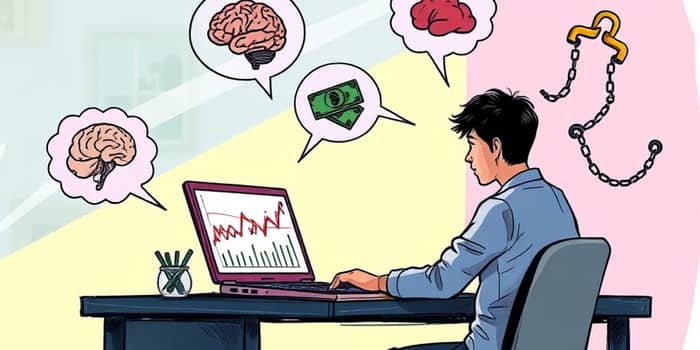
Debt is not just a financial burden; it's a psychological maze that clouds judgment and drains mental energy, often leading us astray from our goals.
Understanding how our minds work is crucial for staying on track financially and emotionally, as biases can silently sabotage our best intentions.
This article explores the hidden biases that shape our debt decisions and financial future, offering a beacon of hope through practical insights.
By unraveling these psychological threads, you can transform debt from a source of stress into a manageable journey toward freedom.
We often evaluate debt through mental shortcuts, similar to how we assess physical pain, which can distort our perceptions.
Duration neglect causes us to ignore loan length, focusing solely on immediate factors like monthly payments.
In experiments, people showed no reduced willingness for loans extended 40% longer with the same monthly payment, highlighting this bias.
This leads to poor choices, such as accepting longer loans with smaller end payments that feel less painful emotionally.
We tend to overweight final payments, avoiding large one-time "pains" and preferring spread-out payments over lump sums.
Here are common biases in debt evaluation that can trap us in cycles:
- Duration neglect: Ignoring the total length of loans in decisions.
- Peak-end rule adaptation: Focusing excessively on the end of payment periods.
- Monthly payment fixation: Overemphasizing monthly costs while overlooking total interest.
Recognizing these patterns is the first step to making wiser financial choices.
The Smallest-Balance Heuristic and Mental Accounting
When managing multiple debts, many prioritize paying off the smallest debt first, known as the smallest-balance heuristic.
This provides a sense of progress and reduces the number of outstanding loans, offering psychological relief.
However, it often increases total interest paid compared to targeting highest-interest debts, a classic case of winning the battle but losing the war.
Mental accounting treats each debt as a separate, painful account, creating a cognitive bandwidth tax.
Clearing one extra debt account improves cognitive functioning by ~0.25 SD and reduces anxiety likelihood by 11%.
To counter this heuristic, consider these strategies:
- List all debts with interest rates and balances for a clear overview.
- Prioritize debts with the highest interest rates for extra payments to minimize costs.
- Use the snowball method only if it motivates you, but be aware of the financial trade-offs.
By consolidating debts, you can reduce mental burden and improve overall well-being.
Cognitive and Emotional Impacts of Chronic Debt
Chronic debt consumes mental bandwidth through constant worry, leading to a bandwidth tax that impairs functioning.
Studies show error rates in cognitive tasks drop from 17% to 4% after debt relief, underscoring the mental toll.
Debt fuels anxiety, with symptoms reducing from 78% to 53% post-intervention, and increases present bias, making us more impulsive.
This emotional strain often drives overspending as a coping mechanism for stress, loneliness, or social comparison.
Here are ways debt affects overall well-being and life satisfaction:
- Reduces life satisfaction, especially with "pure debt" like student loans, which are mentally labeled as repayment-focused.
- Increases negative affect and stress, perpetuating poverty traps through counterproductive decisions.
- Fosters risk aversion and impulsivity, hindering long-term financial planning.
Acknowledging these impacts empowers you to seek healthier coping strategies and support.
Effective Debt Repayment Strategies
Normative advice suggests paying minimums on all debts and targeting the highest-interest one first to minimize total cost.
But behaviorally, we segregate losses and delay payments due to present bias, often overlooking optimal strategies.
Debt aversion makes us favor paying early rather than at the end, even if it's not financially efficient.
Digital payments reduce the pain of paying, making overspending easier and exacerbating debt cycles.
To stay on track, implement these practical steps for better management:
- Consolidate debts to reduce the number of accounts and alleviate mental accounting burdens.
- Set up automatic payments for minimums to avoid late fees and maintain consistency.
- Focus on total cost, not just monthly payments, when taking new loans to avoid duration neglect.
- Use budgeting tools to track spending and identify areas for improvement in real-time.
- Seek professional help if debt becomes overwhelming, as early intervention can prevent escalation.
Consolidation has been shown to improve cognitive functioning more than raw relief amounts, supporting a holistic approach.
Key Statistics and Insights from Research
Understanding the numbers behind debt can empower your decisions and provide a reality check.
Here is a table summarizing key statistics from studies on debt psychology:
These numbers highlight the tangible benefits of addressing debt not just financially, but psychologically.
They reveal how small changes, like clearing an account, can lead to significant mental health improvements.
Personality and Policy Factors in Debt Management
Impulsivity is the top personality predictor of repayment issues, influencing credit attitudes and behaviors significantly.
Other traits, such as risk tolerance and long-term planning, shape how we perceive and handle debt in daily life.
Policies should focus on psychological drivers, such as streamlining accounts to reduce mental accounting and cognitive load.
Debt relief programs that consolidate accounts have shown stronger improvements in well-being than mere financial aid.
Consider these insights for personal growth and advocacy:
- Assess your personality traits related to impulsivity and develop habits to mitigate their effects.
- Advocate for policies that simplify debt structures and provide mental health support alongside financial advice.
- Educate yourself on the psychological aspects of money management to build resilience and informed decision-making.
By integrating psychology with finance, we can create systems that support both economic and emotional health.
Conclusion: Taking Control of Your Debt Journey
Debt is a complex interplay of numbers and emotions, but awareness can transform your approach from confusion to clarity.
Embrace strategies that counter biases, reduce mental burden, and focus on long-term goals for sustainable progress.
Remember, staying on track is not just about paying off money; it's about reclaiming your peace of mind and future.
With the right tools and mindset, you can navigate the psychology of payments and achieve lasting financial well-being.
Start today by reflecting on your debt habits and taking one small step toward change.
References
- https://pmc.ncbi.nlm.nih.gov/articles/PMC7705353/
- https://www.pnas.org/doi/10.1073/pnas.1810901116
- https://thedecisionlab.com/insights/consumer-insights/behavioral-science-of-paying-debts
- https://journals.sagepub.com/doi/10.1509/jmkr.48.SPL.S38
- https://wealthandfinance.digital/the-psychology-of-debt-rewiring-the-brain-for-financial-success/
- https://spssi.onlinelibrary.wiley.com/doi/10.1111/sipr.12074
- https://think.ing.com/articles/the-psychology-of-debt-seeing-debt-for-what-it-is/