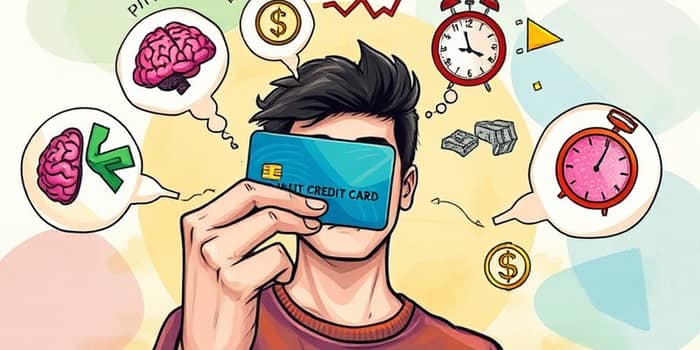
Have you ever wondered why you reach for a credit card in certain situations? It goes beyond mere convenience or necessity. Your borrowing habits are deeply rooted in psychological patterns that influence your decisions every day.
By exploring the psychological ownership of borrowed money, we can uncover why credit feels different from other forms of debt. This insight is the first step toward mastering your financial behavior.
Credit use is not just a financial act; it is a reflection of your inner world. Understanding this can empower you to make smarter choices and avoid the pitfalls of debt.
The Psychology of Ownership in Credit
One key concept is how we perceive borrowed money. Research shows that people often feel they own money from credit more than from loans. This sense of ownership drives willingness to borrow.
This phenomenon is known as psychological ownership of borrowed money. It is a powerful force that can override other financial factors. For instance, studies indicate that credit card usage feels more personal.
This psychological ownership is malleable. Framing debt in less possessive terms can reduce borrowing urges. It is a tool you can use to manage your habits.
Here are some ways psychological ownership varies:
- Higher with credit cards compared to personal loans.
- Influenced by language and marketing.
- Measurable through consumer behavior patterns.
- Predicts search and application activities for credit.
Time and Temptation: How Our Minds Play Tricks
Our brains are wired for immediate gratification. This bias is called temporal discounting and immediate gratification. It makes us prioritize short-term rewards over long-term costs.
Credit systems exploit this by offering instant access to goods. The true cost of borrowing is often obscured. This leads to debt accumulation over time.
Recognizing this tendency is crucial. It allows you to pause and consider the future. Simple strategies like waiting periods can help combat impulsivity.
Your Brain on Credit
Credit cards have a unique effect on our brains. They sensitize reward networks in the brain. This drives increased spending by enhancing the pleasure of purchases.
Neurological studies show that credit usage activates areas linked to rewards. This makes spending feel more exciting. It is a biological response that can be managed with awareness.
Understanding this can help you switch to cash for daily expenses. This reduces the neurological pull of credit. It is a practical step toward financial control.
Who You Are Determines How You Borrow
Your personality traits play a significant role in borrowing behavior. Research identifies six key psychological factors that predict how you handle debt.
- Effective financial decision-making (EDM) leads to more responsible borrowing.
- Self-control (SCR) is crucial for avoiding impulse buys.
- Conscientiousness (CON) is linked to better credit history.
- Selflessness and giving attitude (SGA) can enable debt access.
- Neuroticism (NRT) is associated with fear of borrowing.
- Attitude toward money (ATM) influences how you view credit.
Another trait is the need for arousal. Individuals who seek excitement may favor various loans. This includes home improvement or personal loans.
To illustrate these traits, here is a table summarizing their impact:
Four Lenses on Credit Use
Psychologists view credit use through four main perspectives. Each offers a different insight into why we borrow.
- Credit use as a reflection of the situation: External factors drive borrowing.
- Credit use as a reflection of the person: Individual traits are key.
- Credit use as a cognitive process: Decision-making steps involved.
- Credit use as a social process: Influence of peers and society.
Understanding these perspectives helps you see the bigger picture. It encourages a holistic approach to managing credit. You can address both personal and environmental factors.
Evidence and Insights from Research
Studies provide solid evidence for these psychological concepts. For example, research on psychological ownership shows clear patterns.
- Psychological ownership predicts willingness to borrow using credit cards.
- It also influences personal loan considerations.
- Higher ownership correlates with past credit card usage.
- Search behaviors reflect these psychological differences.
These findings are based on multiple studies with diverse measures. They highlight the malleable and responsive nature of borrowing psychology. This means you can change your habits through awareness.
Research also shows that individual differences are measurable and significant. This allows for personalized financial advice. You can leverage this to improve your credit health.
Key Distinctions to Keep in Mind
Not all debt is perceived the same way. Credit inspires different feelings than loans. This distinction is vital for understanding your behavior.
- Credit cards often feel more like ownership.
- Loans may be seen as more formal obligations.
- Online search behavior varies by debt type.
- Marketing framing can alter perceptions.
These nuances affect how you approach borrowing. Recognizing them can help you choose the right debt tools. It reduces the risk of over-borrowing.
Putting It into Practice: Take Control of Your Credit
Now that you understand the psychology, it is time to apply it. Practical steps can help you manage your borrowing habits effectively.
- Monitor your language around debt to reduce psychological ownership.
- Use cash or debit for daily expenses to minimize neurological rewards.
- Assess your personality traits to identify areas for improvement.
- Set clear financial goals to combat temporal discounting.
- Seek professional advice if needed to address deep-seated patterns.
Remember, your mindset is a powerful tool. By embracing these insights, you can transform your relationship with credit. It leads to a more secure and fulfilling financial future.
Start today by reflecting on your last credit purchase. Ask yourself what drove that decision. Use this awareness to build better habits over time.
Credit is not inherently good or bad. It is how you use it that matters. With psychological understanding, you can borrow wisely and confidently.
References
- https://pmc.ncbi.nlm.nih.gov/articles/PMC8067141/
- https://onlinelibrary.wiley.com/doi/10.1080/00207594.2011.628674
- https://openjournals.libs.uga.edu/fsr/article/download/3296/2924
- https://www.psychologytoday.com/us/blog/pop-culture-mental-health/202504/credit-and-debt-leveraging-the-future-for-the-present
- https://thedecisionlab.com/insights/consumer-insights/behavioral-science-of-paying-debts
- https://www.gsb.stanford.edu/insights/money-you-borrowed-remember-who-owns-it
- https://mitsloan.mit.edu/experts/how-credit-cards-activate-reward-center-our-brains-and-drive-spending