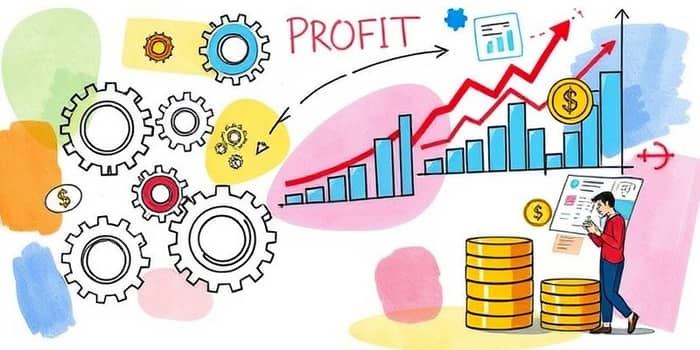
Where do profits come from? This simple question has long eluded traditional economics, which often treats profits as an afterthought or assumes they fade to zero in equilibrium.
Introduced in 1908 by Jerome Levy, the Profits Perspective offers a transformative answer. It views profits as the lifeblood of business activity, driving decisions on employment, output, and investment through dynamic fund flows.
This paradigm challenges neoclassical models by incorporating real-world factors like GDP, personal income, and balance sheet changes. Understanding this shift is crucial for navigating today's volatile economic landscape.
The Historical Evolution of Profit Paradigms
Profit is not a fixed concept; its meaning has evolved dramatically across eras, shaped by technology, power, and capitalism's structure.
As historian Jonathan Levy argues, "the history of profit is a history of power," highlighting how profit measurement reflects societal forces and control.
To grasp this journey, consider four key regimes that have defined profit from pre-1850 to the present. Each era reveals a different approach to wealth and value creation.
This table illustrates how profit concepts have shifted from tangible assets to financial abstractions. The evolution underscores that profit is constructed and power-laden, not intuitive.
Key trends include the rise of financialization, where value decouples from physical production.
- Pre-1850: Profit was about surplus and avoiding debt.
- 1850-1920: Industrial efficiency drove profit maximization.
- 1920-1980: Corporate accounting emphasized long-term stability.
- 1980-present: Financial engineering dominates profit generation.
Current Profit Challenges and Neoclassical Critiques
Modern profit paradigms face significant pitfalls, often trapped in narrow views that ignore broader economic impacts.
One major issue is financialization dominance, where profits stem from balance sheet manipulation rather than goods or services.
This has led to a decoupling from real investment, as seen in examples like derivatives trading.
Another challenge is the neglect of externalities, where costs are borne by society or the environment.
Accounting complexities add opacity, with intangible assets and fair value measurements creating uncertainty.
- Profits derived from financial assets, not production.
- Ignoring externalities like environmental damage.
- Difficulty in valuing intangible assets such as intellectual property.
- Historical cost accounting versus current market expectations.
The neoclassical paradigm assumes profits gravitate to zero, but real economies experience swings that are vital for survival.
For instance, Tesla's recent profitability highlights how balance sheet changes can overshadow core operations.
This narrow focus can lead to short-termism and unsustainable practices.
Paradigm Shifts in Business: Triggers and Strategies
A paradigm shift involves a major change in production or service methods, often driven by technology or customer needs.
This shift is essential for moving beyond growth obsession to embrace profitability and sustainability.
Triggers include new technologies that alter operations, such as automation or digital platforms.
Prioritizing customers ensures smoother transitions and aligns business goals with market demands.
- Adopt innovative technologies to boost efficiency and quality.
- Focus on customer feedback for continuous improvement.
- Integrate sustainability metrics into performance evaluations.
- Shift from shareholder primacy to stakeholder capitalism.
Balancing profit and purpose requires businesses to address their impact on people and planet.
Concepts like the triple bottom line and ESG aim for win-win scenarios, but must question profit's true derivation.
Practical strategies include leveraging the dynamic Profits framework for better forecasting and decision-making.
Key Numbers and Data Points to Remember
Understanding profit paradigms requires awareness of critical historical and modern data.
These numbers highlight milestones in the evolution and current state of profit thinking.
- 1908: Origin of Jerome Levy's profits equation.
- 1850: Start of industrial profit regimes.
- 1920: Beginning of multinational accounting era.
- 1970: Milton Friedman's profit-maximization essay.
- 1980s-present: Rise of financialization.
- 2018: John Elkington recalls the triple bottom line.
- 2020: 80% of IPO firms had negative earnings.
- Tesla's record profits in recent quarters from non-core activities.
These data points underscore the shifting nature of profit and the need for adaptive frameworks.
Implications for Forecasting and Economic Behavior
Shifting to a Profits Perspective has profound implications for economic analysis and investment.
By incorporating aggregate demand structure and fund flows, businesses can predict trends more accurately.
This approach reveals how profits motivate behavior, from job creation to market expansions.
Hyman Minsky integrated this into his financial instability hypothesis, emphasizing profits' role in stability.
Future paradigms will likely alter capitalism, emphasizing adaptability and holistic analysis.
- Improved forecasting of economic cycles and crises.
- Better risk assessment for investments and policies.
- Enhanced strategies for sustainable business growth.
- Greater transparency in profit reporting and accountability.
Embracing this shift fosters resilience and innovation in a rapidly changing world.
Conclusion: Redefining Profit for a Better Future
In conclusion, the profit paradigm is evolving from static, narrow views to dynamic, inclusive approaches.
As Leon Levy noted, understanding profit sources is key to economic system behavior.
This shift calls for balancing profitability and sustainability to create positive impacts.
Quotes from thinkers like Minsky, Carnegie, and Friedman remind us that profits motivate, but their definition must evolve.
By adopting the Profits Perspective, businesses and societies can navigate uncertainties and build a more equitable economy.
Embrace this change to unlock new opportunities and drive meaningful progress in the years ahead.
References
- https://www.levyforecast.com/profits-perspective/
- https://embodied-economics.ghost.io/probing-our-profit-paradigms-part-1/
- https://www.tromml.com/post/the-profit-paradigm
- https://www.indeed.com/career-advice/career-development/paradigm-shift-business
- https://www.strategydriven.com/2024/10/24/balancing-profit-and-purpose-the-new-business-paradigm/
- https://bthechange.com/its-time-for-a-new-paradigm-of-business-2ad42d44b36e