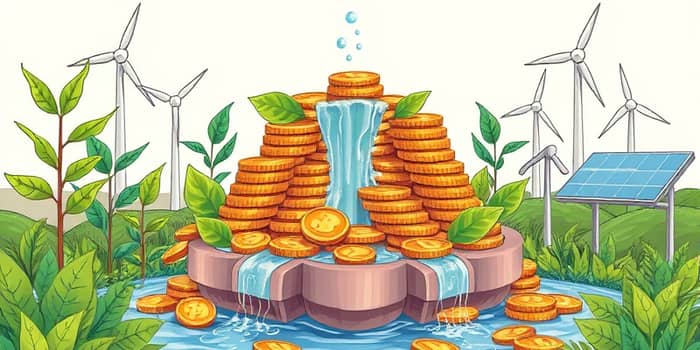
Imagine a world where financial resources flow endlessly, like a fountain, nurturing economies and communities toward sustainable growth.
The concept of fiscal policy and sustainable financing transforms this vision into reality, offering tools to generate and renew wealth without depletion.
By mastering these strategies, governments, businesses, and individuals can unlock a future of resilience and prosperity, making financial scarcity a thing of the past.
This article explores how to cultivate such endless resources through practical, innovative approaches.
It delves into the mechanisms that drive economic stability and environmental harmony.
You will discover actionable steps to implement these ideas in your own context.
Understanding Fiscal Policy Basics
Fiscal policy is the government's use of spending, taxation, and borrowing to shape the economy.
It directly influences resource allocation, income redistribution, and macroeconomic stability.
Key components include public expenditure and revenue generation, which work alongside monetary policy to align output with potential GDP.
For instance, during economic downturns, increased government spending can boost demand and create jobs.
This approach, rooted in Keynesian theory, helps manage inflation and unemployment effectively.
Understanding these basics is crucial for leveraging fiscal tools sustainably.
Building Sustainable Revenue Streams
Sustainable revenue streams ensure that financial resources are renewable and long-lasting.
Taxation serves as a primary tool, with methods designed to minimize economic strain.
- Progressive taxes that adjust rates based on income levels.
- Value-added tax (VAT) hikes, such as Ghana's 2.5% increase for health insurance.
- Sector-specific taxes on transportation, services, and production activities.
Fiscal space measures the room for new resources without jeopardizing stability.
It includes growth-generated funds and revenue increases from efficient tax systems.
Governments can also tap into reserves or use seigniorage from money printing.
These strategies help build a robust financial foundation for future needs.
Green and Sustainable Financing Arsenal
Sustainable financing extends fiscal concepts to align with environmental and social goals.
It mobilizes resources for projects that support resilient economies and the Sustainable Development Goals (SDGs).
Instruments like green bonds and impact investing offer non-debt options for renewal.
These tools create a fountain-like renewal of resources, ensuring continuous flow for eco-friendly initiatives.
They help manage risks like climate change while promoting economic growth.
Case Studies and Mechanisms
Real-world examples illustrate how these strategies work in practice.
Ghana's increase in VAT by 2.5% funded national health insurance, showcasing effective tax-based revenue.
Kenya implemented exit taxes on healthcare personnel to retain professionals and generate funds.
Historical shifts like post-2008 Quantitative Easing involved central banks buying government bonds to stimulate economies.
This demonstrates how fiscal and monetary policies can collaborate during crises.
Crowdfunding platforms have enabled small businesses to access capital without traditional loans.
These mechanisms highlight the versatility of sustainable financing in various contexts.
Challenges and Risks
Implementing these strategies is not without obstacles.
Debt sustainability is a critical concern, as excessive borrowing can lead to financial instability.
- Societal resistance to tax increases, requiring public education and transparency.
- Balancing economic growth with environmental and social priorities.
- Managing climate and social risks in investment decisions.
Fiscal rules help constrain policy via indicators like budget balance and debt levels.
They anchor expectations and ensure long-term viability of financial plans.
Without proper management, resources may deplete rather than renew.
Addressing these challenges involves collaboration and adaptive strategies.
Future Outlook
The future of financial resources lies in innovation and integration.
Blended finance combines public and private funds to promote liquidity and ESG expansion.
It supports solidarity economy shifts, moving from Wall Street models to community wealth building.
Sustainable financing tools are evolving rapidly to include more accessible options.
Advances in technology enable new forms of crowdfunding and impact measurement.
Governments are increasingly adopting green bonds to fund infrastructure projects.
This outlook promises a more resilient and equitable global economy.
Practical Steps for Stakeholders
To cultivate endless financial resources, stakeholders can take actionable steps.
Governments should focus on designing progressive tax systems and enforcing fiscal rules.
- Conduct regular assessments of fiscal space to identify funding opportunities.
- Invest in public goods like education and healthcare to boost long-term growth.
- Promote public-private partnerships for sustainable project funding.
Businesses can leverage sustainable financing instruments to align with ESG factors.
- Explore green bonds for capital-intensive environmental projects.
- Engage in impact investing to achieve social and financial returns.
- Use crowdfunding to validate products and build community support.
Individuals and nonprofits should advocate for transparent policies and participate in community financing.
They can also adopt financial planning that prioritizes redistribution and risk management.
By following these steps, everyone can contribute to a sustainable fiscal fountain.
Start today by evaluating your current resources and exploring new financing options.
References
- https://www.cfp.pt/en/glossary/fiscal-policy
- https://www.kickfurther.com/blog/sustainable-financing-funding-strategies-for-green-businesses
- https://equalsmoney.com/financial-glossary/fiscal-policy
- https://www.financialpipeline.com/fiscal-policy-definition/
- https://pmc.ncbi.nlm.nih.gov/articles/PMC11698114/
- https://www.federalreserve.gov/faqs/money_12855.htm
- https://resourcegeneration.org/transformative-investment-principles/
- https://www.businessnewsdaily.com/3484-fiscal-policy.html
- https://unglobalcompact.org/compactjournal/sustainable-finance-explained-why-it-matters-and-how-your-business-can-lead
- https://en.wikipedia.org/wiki/Fiscal_policy
- https://finance.ec.europa.eu/sustainable-finance/overview-sustainable-finance_en
- https://www.congress.gov/crs-product/IF11253
- https://extension.harvard.edu/blog/what-is-sustainable-finance-and-why-is-it-important/
- https://www.worldbank.org/en/topic/fiscalpolicy
- https://www.infinitegiving.com/blog/financial-sustainability-for-nonprofit-organizations
- http://resourcegeneration.org/redistribution-guidelines/