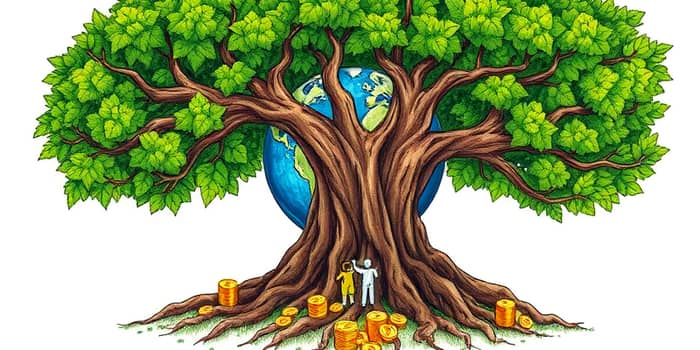
Building wealth in today’s world requires more than just financial savvy—it demands a deep commitment to ecological health, social justice, and purposeful legacy. Sustainable wealth blends monetary growth with positive impact, ensuring prosperity for generations to come.
Defining Sustainable Wealth and Investing
Sustainable wealth is a paradigm shift from traditional wealth models. It reframes success as holistic life that is rich in experiences and rooted in the understanding that our planet’s resources are finite. Rather than focusing solely on account balances, sustainable wealth emphasizes harmony between economic vitality and environmental boundaries.
At its core, sustainable wealth creation links environmental integrity with social progress and long-term financial security. This integrated model values relationships, health, and community alongside material assets, recognizing that true prosperity extends beyond individual gain.
Why Sustainable Wealth Matters
The world faces mounting systemic risks: climate change, resource scarcity, social unrest, and governance failures. Sustainable investing addresses these challenges by anticipating threats and aligning capital with resilience strategies.
- Environmental: carbon emissions, waste management, biodiversity loss
- Social: labor practices, diversity, community relations
- Governance: board structure, executive pay, anti-corruption controls
By considering these ESG factors, investors can mitigate risks like regulatory fines, stranded assets, or reputational damage. Evidence shows that portfolios incorporating sustainability criteria often match or outperform conventional benchmarks over the long run.
Moreover, aligning investments with core values creates a profound connection between wealth and purpose, transforming financial gains into tools for positive change.
Main Approaches to Sustainable Investing
Investors today have a rich toolkit for directing capital toward sustainability goals. Each approach offers distinct benefits, from risk mitigation to targeted impact:
- Negative (exclusionary) screening
- Positive / best-in-class screening
- ESG integration
- Thematic investing
- Impact investing
- Active ownership / stewardship
Negative screening removes companies at odds with your values—such as fossil fuels or weapons—while best-in-class screening rewards leaders within each sector. ESG integration weaves sustainability data into traditional analysis, and thematic investing hones in on trends like renewable energy or sustainable agriculture.
Impact investing goes further by targeting measurable social or environmental outcomes alongside financial returns, often through private equity, community finance, or specialized funds.
Principles of Sustainable Wealth Management
- Long-term perspective and multi-generational goals
- Comprehensive risk management, including ESG scenarios
- Diversification across traditional and sustainable assets
- Transparency in reporting and accountability
- Alignment of investments with personal or family values
Effective management integrates multi-decade thinking and intergenerational stewardship, ensuring assets endure while generating positive externalities. Transparent frameworks allow stakeholders to track both financial performance and societal contributions.
Implementing Sustainable Wealth: Practical Frameworks
Translating principles into practice requires structured tools and cohesive governance. An Investment Policy Statement (IPS) should articulate sustainability objectives, exclusions, impact targets, time horizons, and risk tolerances. Embedding these guidelines within the IPS creates a clear roadmap for portfolio construction and evaluation.
Family offices and individual investors can establish governance structures—such as family councils or charters—that formalize decision-making roles and uphold shared values. Regular meetings foster dialogue across generations, educating heirs on responsible investing and stewardship duties.
Philanthropy and investing should operate in concert rather than isolation. Deploying all available tools to achieve impact goals means coordinating grants, program-related investments, and mission-aligned portfolios. This holistic strategy amplifies social benefits while preserving capital for future initiatives.
Practical techniques include scenario analysis for climate-related risks, stress testing against regulatory shifts, and using sustainability-linked bonds whose terms adjust based on carbon reduction targets. These instruments reward issuers for improved performance and hold them accountable to ambitious benchmarks.
Educational programs and advisory partnerships further empower investors. Workshops on ESG metrics, impact measurement, and emerging technologies equip families and individuals to make informed choices that transcend market cycles.
Measuring Success and Legacy
Sustainable wealth is not static—it evolves with changing societal needs and environmental conditions. Establishing key performance indicators (KPIs) across financial, environmental, and social dimensions allows regular assessment of both returns and impact.
Reporting frameworks such as the Global Reporting Initiative (GRI) or the UN Sustainable Development Goals (SDGs) offer standardized criteria for evaluating progress. By aligning with these benchmarks, investors demonstrate accountability and contribute to broader global efforts.
Ultimately, the true measure of success lies in the stories of communities uplifted, ecosystems restored, and future leaders inspired. Wealth becomes a legacy not defined by how much was accumulated, but by how much good was sown.
In a world of tightening planetary boundaries and growing social demands, sustainable wealth offers a path to enduring prosperity. By weaving environmental integrity, social justice, and sound governance into financial decisions, we can build a better tomorrow—for our families, our communities, and our planet.
References
- https://www.imd.org/blog/sustainability/sustainable-investing/
- https://prosperityroad.com/2024/06/10/sustainable-wealth-management/
- https://lifestyle.sustainability-directory.com/term/sustainable-wealth-creation/
- https://internationalbanker.com/brokerage/sustainable-wealth-management-is-aligning-investors-values-with-their-wealth/
- https://www.ubs.com/global/en/wealthmanagement/what-we-offer/investing/sustainable-investing.html
- https://am.jpmorgan.com/no/en/asset-management/per/investment-themes/esg/what-are-the-different-approaches-to-sustainable-investing/
- https://worthadvisors.com/creating-sustainable-wealth-strategies-for-generational-prosperity/
- https://www.ussif.org/education/new-the-sustainable-investing-roadmap-series-for-financial-advisors
- https://privatebank.jpmorgan.com/nam/en/services/portfolio-management/sustainable-investing
- https://majorsustainability.smeal.psu.edu/concepts-4/sustainable-investing/
- https://www.rock-wealth.co.uk/sustainable-investing/
- https://greenbusinessbureau.com/industries/sustainable-wealth-management-getting-started-guide-for-investment-management-companies/
- https://www.morganstanley.com/what-we-do/wealth-management/private-wealth-management/sustainable-investing
- https://www.pbig.ml.com/solutions/impact-investing
- https://institutional.fidelity.com/advisors/investment-solutions/strategies/sustainable-investing-esg